
Non-Laser Surgery
Non-laser eye surgery refers to corrective procedures performed without the use of laser technology, utilizing traditional surgical instruments such as scalpels or micro-surgical tools instead. These techniques can be highly effective in treating conditions like myopia (nearsightedness), hyperopia (farsightedness), and astigmatism when laser correction is not suitable. In such cases, alternatives like implantable contact lenses (ICL) or refractive lens exchange (RLE) may be recommended to restore clear vision. Depending on individual health factors and eye structure, non-laser methods may offer a safer, more precise, and highly controlled approach — achieving excellent results even without laser assistance.
Smart Lenses
Smart lenses are advanced optical implants designed to correct refractive errors such as myopia (nearsightedness), hyperopia (farsightedness), and astigmatism. Featuring cutting-edge technology, these lenses can automatically adjust focus and enhance visual clarity, providing seamless correction for both near and distance vision. They offer a flexible, long-term alternative to traditional glasses or contact lenses. Some smart lenses are also equipped with innovative features that monitor health indicators, such as glucose levels, or adapt to varying light conditions. Beyond vision correction, smart lenses represent the future of personalized eye care — combining medical precision with intelligent technology to redefine how vision is enhanced and maintained.
Non-Surgical Eye Aesthetics
Non-surgical eye aesthetics encompasses cosmetic treatments that rejuvenate and enhance the eye area without the need for surgery. These procedures address common concerns such as under-eye bags, dark circles, drooping eyelids, and fine lines. Popular non-surgical options include dermal fillers, Botox, and platelet-rich plasma (PRP) therapy. Dermal fillers restore lost volume under the eyes and smooth wrinkles for a youthful, refreshed appearance. Botox relaxes the muscles around the eyes to reduce crow’s feet and create a more rested look. PRP therapy, which uses the patient’s own plasma, stimulates collagen production and revitalizes the delicate skin around the eyes. Offering minimal risk and downtime, non-surgical eye aesthetic treatments provide natural-looking rejuvenation with quick recovery and long-lasting results.
Surgical Eye Aesthetics
Surgical eye aesthetics includes procedures such as blepharoplasty and oculoplastic surgery, aimed at enhancing the appearance and function of the eye area.
Blepharoplasty removes excess skin and fat from the eyelids to correct sagging and puffiness, restoring a more youthful, alert expression.
Oculoplastic surgery combines aesthetic and reconstructive techniques to treat both cosmetic and functional issues, such as eyelid malpositions, tear duct problems, or orbital conditions.
These surgical procedures not only rejuvenate the eye region and reduce under-eye bags, fine lines, and crow’s feet but can also improve vision in cases where drooping eyelids obstruct sight.
The result is a refreshed, balanced, and natural appearance that enhances both confidence and overall eye health.
Cataract Surgery (Fako)
Phacoemulsification, commonly known as Fako, is a modern, minimally invasive cataract surgery technique in which a small incision is made, and ultrasonic waves are used to break up the cloudy natural lens. The fragmented lens is then gently removed, and a clear intraocular lens (IOL) is implanted to restore vision.
Depending on the patient’s visual needs, different types of IOLs can be used, including monofocal, monofocal toric, trifocal, or trifocal toric lenses.
In Fako with a monofocal IOL, the procedure provides sharp vision at a single distance—most commonly for distance vision. For patients with astigmatism, a toric monofocal IOL can be chosen to correct this condition and improve clarity.
In Fako with a trifocal IOL, the implanted lens allows for clear vision at three focal distances: near, intermediate, and far. If astigmatism is present, a toric trifocal IOL may be used, providing sharp focus across all three ranges while simultaneously correcting astigmatism.
Phacoemulsification offers fast recovery, minimal discomfort, and long-lasting visual improvement, making it one of the most advanced and preferred methods for cataract treatment today.
Corneal Cross-Linking (CXL)
Corneal Cross-Linking (CXL) is an advanced treatment used to halt the progression of keratoconus, a condition in which the cornea weakens and gradually bulges outward. The goal of this procedure is to stabilize the corneal structure and prevent further deterioration of vision.
During the treatment, riboflavin (vitamin B2) drops are applied to the cornea, followed by controlled exposure to ultraviolet (UV) light. This interaction strengthens the corneal tissue by creating new bonds between collagen fibers, increasing its rigidity and stability.
CXL is a minimally invasive procedure that helps preserve vision, reduce the need for corneal transplantation, and maintain the natural shape of the eye.
DSR for Tear Duct
DSR (Dacryo-Sinusography) is a specialized diagnostic imaging technique used to evaluate the tear duct system, also known as the lacrimal drainage system. The procedure involves injecting a contrast agent into the tear duct and capturing X-ray images to visualize the flow and identify any blockages, narrowing, or structural abnormalities within the ducts.
DSR is particularly useful in diagnosing conditions such as nasolacrimal duct obstruction or dacryocystitis, where improper tear drainage can cause excessive tearing, inflammation, or infection. This precise imaging method helps clinicians determine the most effective treatment plan for restoring normal tear flow and eye comfort.

DSR + Laser for Tear Duct
DSR + Laser is a combined diagnostic and therapeutic approach used to treat tear duct blockages. The procedure begins with Dacryo-Sinusography (DSR), which allows detailed imaging of the tear drainage system using contrast material. Following diagnosis, a laser is applied to open or widen the obstructed tear ducts, enhancing tear flow and drainage.
This minimally invasive technique is particularly beneficial when traditional treatments—such as probing or conventional surgery—are ineffective. The laser energy precisely removes obstructions, relieving symptoms like chronic tearing, inflammation, and recurrent infections, while promoting faster recovery and improved eye comfort.
Laser Treatments
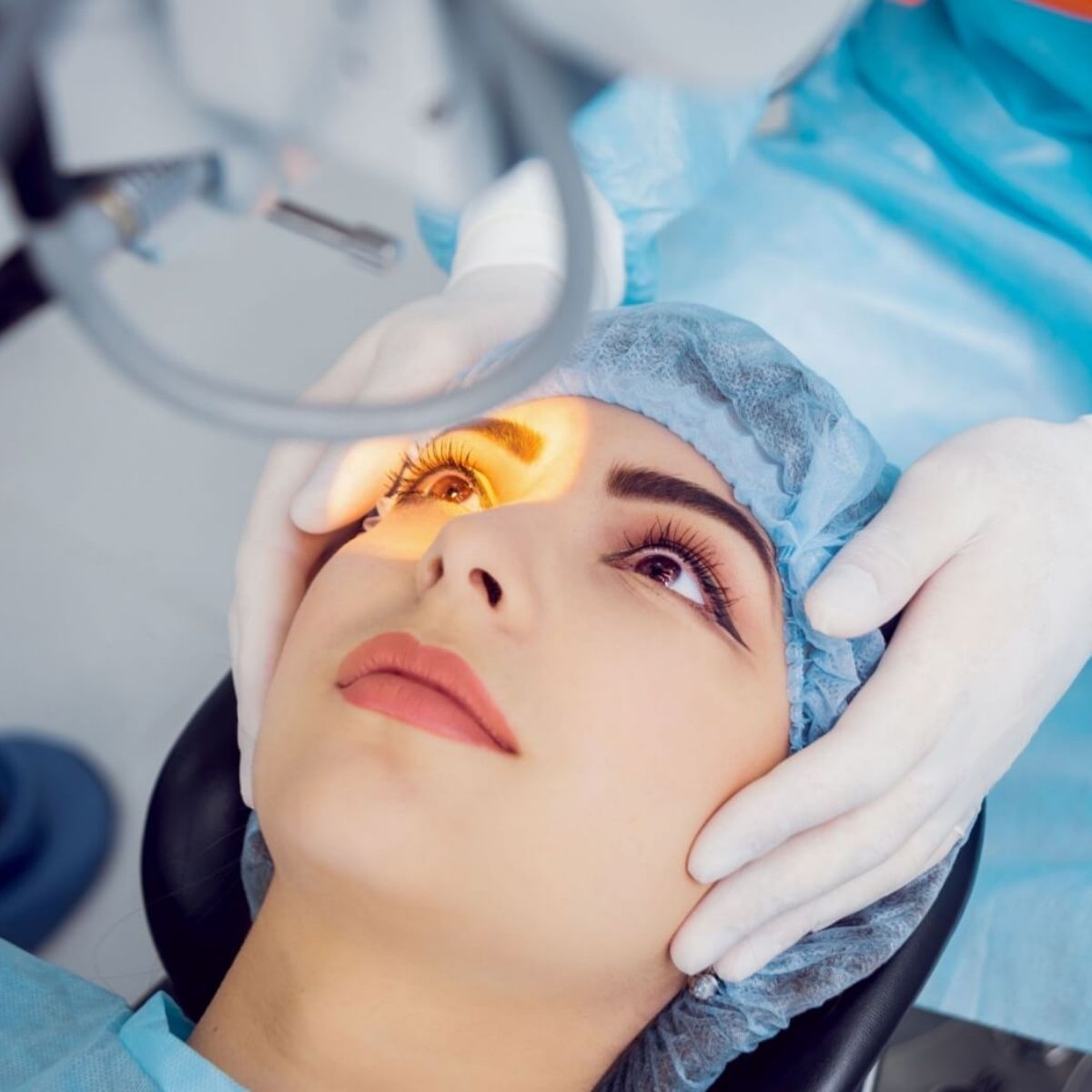
ReLEx SMILE (Small Incision Lenticule Extraction) is a state-of-the-art, minimally invasive laser eye surgery designed to correct refractive errors such as nearsightedness (myopia) and astigmatism. Unlike traditional LASIK, ReLEx SMILE does not require the creation of a corneal flap. Instead, a small incision is made through which a thin lenticule — a disc-shaped piece of tissue — is removed, reshaping the cornea to improve vision. This technique offers reduced discomfort, quicker recovery, and greater corneal stability compared to conventional methods.
FemtoLASIK is an advanced evolution of LASIK surgery that uses a femtosecond laser to create the corneal flap, replacing the traditional mechanical microkeratome. This laser-assisted precision enhances safety, accuracy, and visual outcomes while minimizing healing time. FemtoLASIK effectively treats myopia (nearsightedness), hyperopia (farsightedness), and astigmatism, providing patients with clearer vision and reduced dependence on glasses or contact lenses.
Presbyond is an innovative laser treatment developed to correct presbyopia, the age-related decline in near vision that typically affects individuals over 40. Utilizing femtosecond laser technology, Presbyond creates customized optical zones on the cornea, enabling simultaneous focus for both near and distant objects. This approach allows patients to reduce or eliminate the need for reading glasses or bifocals, restoring natural visual flexibility.
PRK (Photorefractive Keratectomy) is a laser eye surgery that reshapes the cornea to correct myopia, hyperopia, and astigmatism. Unlike LASIK, PRK does not involve creating a corneal flap. Instead, the outer corneal layer (epithelium) is gently removed before the laser reshapes the underlying tissue. TransPRK, an advanced, no-touch version of PRK, performs both steps with the same laser, enhancing precision and safety. Both PRK and TransPRK are ideal for patients with thinner corneas or those who are not suitable candidates for LASIK, offering effective and lasting visual correction.